
Four ways Google Cloud helps build data strength in Google Marketing Platform
Data strength is how our clients are pulling ahead in this AI era. For mid-to-large enterprises, bolstering your digital marketing stack with a modern approach to cloud data is a great way to increase your teams’ capabilities, and increasingly, an important part of staying competitive.

Colin Temple
SVP, Data Solutions
With a 25-year career in digital and 15 years at Napkyn, Colin leads our Data Solutions team. Through that role, he oversees the growth of our capabilities and offerings, ultimately helping our customers succeed with their data.
Data strength is how our clients are pulling ahead in this AI era. For mid-to-large enterprises, bolstering your digital marketing stack with a modern approach to cloud data is a great way to increase your teams’ capabilities, and increasingly, an important part of staying competitive.
In short, “data strength” means having robust data assets that power your decision-making across the board, most notably today to inform AI features in your enterprise, such as agentic AI or marketing bidding and audience optimizations. Google, in particular, is pointing at this organizational trait as a critical part of success today.
Napkyn has preached that since it was founded in 2009, when the kind of AI we have today was widely unknown. The now widely-cited adage of “garbage in, garbage out” was always a mantra for us. Even when the intelligence behind every business decision was natural, proficiency with data was a core muscle behind the growth of many enterprises, and Napkyn has long put our focus there.
This week, I am in Las Vegas to participate in Google Cloud Next ‘26. I love this event, because I get to lean on what makes Napkyn different from most of the other companies that look like us in the digital marketing space.
For us, the interplay between the technology underlying data and the business realities it represents have always been primary, so being ahead of the game here makes it fun to explore the new tech in real time. And of course, when it comes to our work with Google’s tech stack, the links between Google Marketing Platform and Google Cloud are a great way to realize the benefits of that data quickly.
So, with that, here are four ways that Google Cloud gives you tools that can help you build data strength to power your Google Marketing Platform performance.
1: It lets your subject matter experts dive deep
Many of the Google Marketing Platform products have mechanisms for exporting their data to Google BigQuery.
Google Analytics 360, of course, is a big one, and for many years you have been able to export the raw data from your GA properties into BigQuery. Today, that includes Fresh Daily Streaming and Daily varieties. I especially like the GA data set for exploring alternative attribution models and for easily comparing your observed, consented reporting alongside the modeled version GA gives you when you use consent mode. This gives you more understanding of how consent choices impact your data, and change over time.
GA is perhaps the most common integration here, but it’s hardly the only one. BigQuery Data Transfer Service for platforms like Display & Video 360 and Search Ads 360 (as well as many other Google and non-Google platforms) give you customizable sets of reporting tables, giving you a fairly turnkey way to introduce data from those platforms into your data lake, where they can be joined with other data, or modeled in ways that aren’t possible with built-in platform reporting.
Your domain experts can explore, validate and glean insights from that data, and doing that well has never been easier.
2: It helps you leverage what others have done
One of the coolest things that Google’s teams have built that connects the dots between your data in BigQuery and Google Marketing Platform is Cortex Framework.
If you’re not familiar with it, Cortex Framework is, at its most basic level, an open source set of deployable solutions for Google Cloud that stand up typical business solutions in a simplified, yet coherent, way. It’s a fine example of really living the age-old advice, “let’s not reinvent the wheel”.
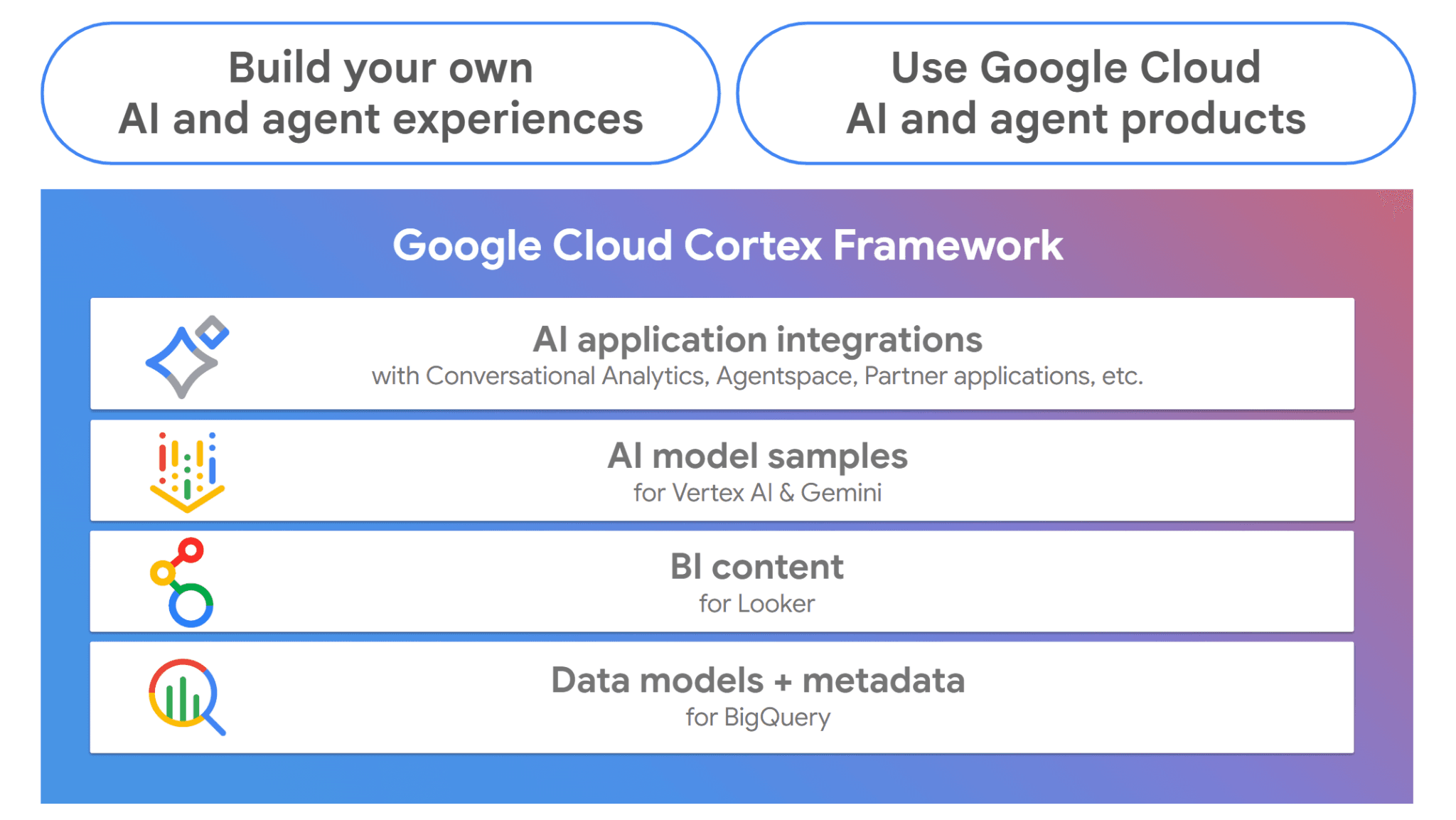
You can use Cortex Framework to accomplish obtaining the data mentioned above, in addition to incorporating data from other common sources. You can also use it to activate solutions for AI modeling, conversational analytics, or reporting with Looker.
Something I really like about Cortex, in contrast with a number of the all-in-one data integration platforms, is how much control you maintain as the organization using it. Data lives in your own Cloud projects.
The code is accessible and can be adjusted or extended to build novel and business-specific solutions on top of its foundation. And it’s done without vendor lock-in, letting you move or replicate that data between cloud environments, archive it on premises, whatever you need.
While you use it in Google Cloud, you pay for the infrastructure you actually use, but you’re not paying a subscription just to maintain access to your own organizational knowledge forever.
3: It lets you build new capabilities quickly, at a higher level
Google Marketing Platform itself is bringing more AI features into the fold, with better and better data integration and modelling capabilities making leveraging AI directly into these products easier for everyone.
At the enterprise level, the competitive edge comes from leveraging those data assets with Google Cloud. What Google Cloud does with agentic AI can elevate the work of your analysts and marketing practitioners. If you employ Gemini, especially Gemini Enterprise, they can more easily take action in platforms through Google’s APIs to build analytics workflows and explore data.
Outside of Gemini directly, built-in AI features in BigQuery also open up easier exploration of the data described above.
Perhaps most importantly, Google Cloud lets you roll out enterprise-grade agentic AI in a way that’s safe and context-aware, letting your team unlock capabilities without everything they produce hitting the this-is-average feel that AI-generated contributions often produce.
4: It enables keeping your strength up
Of course, data strength means more than just building integrations and infrastructure. There are ongoing challenges that come into play after you stand up solutions like this.
Any technical solution complex enough to be talked about needs some kind of maintenance to keep it running smoothly. If the technical processes behind any business-critical solution aren’t looked after, new risks emerge.
When it comes to a data foundation, that means erosion of trust in the knowledge that stands on top of it, the decisions made using it, and the actions that result.
This is the draw for many of the SaaS platforms out there: Maybe you don’t fully own your data, but at least someone else carries the burden of keeping it reliable.
Cortex Framework helps in this regard by existing as an open-source platform that is maintained by Google and the community around Google Cloud. But Google Cloud itself also has solutions to help you keep your data reliable and trustworthy.
We’ve employed a number of the monitoring capabilities of Google Cloud on top of Google Marketing Platform data, for instance, to ensure the right people know when data changes.
Sometimes this is simply to ensure that red flags are flown whenever there’s a problem, so that data pipelines never fail in silence, only to have someone discover a data gap days, weeks or months later.
Sometimes, this comes much closer to day-to-day operations in marketing, notifying us or our clients when thresholds are met in media spending or performance metrics, helping with pacing or ongoing performance management. Agentic AI is also a great way to get this stuff going quickly: we’ve been experimenting in that arena lately, so reach out for tips!
—
At Napkyn, we are big on enterprises owning their own data and the solutions they build. This is part of the reason we continue to partner with Google: their platforms are typically built to surface their underlying data easily, rather than hold onto it, and let customers control their data infrastructure in important ways.
To my mind, this approach lets us hit a sweet spot for our customers. We get to provide solutions that are fit for purpose and tailored for their unique needs, without assuming the burden of maintaining an entirely-custom software stack. And we get to unleash their teams’ capabilities in safe, cost-effective ways, without over-engineering.
Finally, because it’s the data that represents their businesses, we get to see the impact we have on helping their teams drive growth. Reach out to us if you’d like to learn more about how, and let us know if you’re at Cloud Next this week!
More Insights

Building Scalable Serverless Data Pipelines on Google Cloud

Cem Bakar
Cloud Architect
Oct 7, 2026
Read More
Understanding the IAB TCF v2.3 Update: New Vendor Disclosure Requirements Explained

Rob English
Director, Data Solutions
Jun 17, 2026
Read More
CM360 Path to Conversion Reporting: Full Customer Journey Attribution

Monika Boldak
Associate Director, Marketing
Jun 3, 2026
Read More
More Insights
Sign Up For Our Newsletter

Napkyn Inc.
204-78 George Street, Ottawa, Ontario, K1N 5W1, Canada
Napkyn US
6 East 32nd Street, 9th Floor, New York, NY 10016, USA
212-247-0800 | info@napkyn.com


Four ways Google Cloud helps build data strength in Google Marketing Platform
Data strength is how our clients are pulling ahead in this AI era. For mid-to-large enterprises, bolstering your digital marketing stack with a modern approach to cloud data is a great way to increase your teams’ capabilities, and increasingly, an important part of staying competitive.
Colin Temple
SVP, Data Solutions
April 21, 2026
With a 25-year career in digital and 15 years at Napkyn, Colin leads our Data Solutions team. Through that role, he oversees the growth of our capabilities and offerings, ultimately helping our customers succeed with their data.
Data strength is how our clients are pulling ahead in this AI era. For mid-to-large enterprises, bolstering your digital marketing stack with a modern approach to cloud data is a great way to increase your teams’ capabilities, and increasingly, an important part of staying competitive.
In short, “data strength” means having robust data assets that power your decision-making across the board, most notably today to inform AI features in your enterprise, such as agentic AI or marketing bidding and audience optimizations. Google, in particular, is pointing at this organizational trait as a critical part of success today.
Napkyn has preached that since it was founded in 2009, when the kind of AI we have today was widely unknown. The now widely-cited adage of “garbage in, garbage out” was always a mantra for us. Even when the intelligence behind every business decision was natural, proficiency with data was a core muscle behind the growth of many enterprises, and Napkyn has long put our focus there.
This week, I am in Las Vegas to participate in Google Cloud Next ‘26. I love this event, because I get to lean on what makes Napkyn different from most of the other companies that look like us in the digital marketing space.
For us, the interplay between the technology underlying data and the business realities it represents have always been primary, so being ahead of the game here makes it fun to explore the new tech in real time. And of course, when it comes to our work with Google’s tech stack, the links between Google Marketing Platform and Google Cloud are a great way to realize the benefits of that data quickly.
So, with that, here are four ways that Google Cloud gives you tools that can help you build data strength to power your Google Marketing Platform performance.
1: It lets your subject matter experts dive deep
Many of the Google Marketing Platform products have mechanisms for exporting their data to Google BigQuery.
Google Analytics 360, of course, is a big one, and for many years you have been able to export the raw data from your GA properties into BigQuery. Today, that includes Fresh Daily Streaming and Daily varieties. I especially like the GA data set for exploring alternative attribution models and for easily comparing your observed, consented reporting alongside the modeled version GA gives you when you use consent mode. This gives you more understanding of how consent choices impact your data, and change over time.
GA is perhaps the most common integration here, but it’s hardly the only one. BigQuery Data Transfer Service for platforms like Display & Video 360 and Search Ads 360 (as well as many other Google and non-Google platforms) give you customizable sets of reporting tables, giving you a fairly turnkey way to introduce data from those platforms into your data lake, where they can be joined with other data, or modeled in ways that aren’t possible with built-in platform reporting.
Your domain experts can explore, validate and glean insights from that data, and doing that well has never been easier.
2: It helps you leverage what others have done
One of the coolest things that Google’s teams have built that connects the dots between your data in BigQuery and Google Marketing Platform is Cortex Framework.
If you’re not familiar with it, Cortex Framework is, at its most basic level, an open source set of deployable solutions for Google Cloud that stand up typical business solutions in a simplified, yet coherent, way. It’s a fine example of really living the age-old advice, “let’s not reinvent the wheel”.
You can use Cortex Framework to accomplish obtaining the data mentioned above, in addition to incorporating data from other common sources. You can also use it to activate solutions for AI modeling, conversational analytics, or reporting with Looker.
Something I really like about Cortex, in contrast with a number of the all-in-one data integration platforms, is how much control you maintain as the organization using it. Data lives in your own Cloud projects.
The code is accessible and can be adjusted or extended to build novel and business-specific solutions on top of its foundation. And it’s done without vendor lock-in, letting you move or replicate that data between cloud environments, archive it on premises, whatever you need.
While you use it in Google Cloud, you pay for the infrastructure you actually use, but you’re not paying a subscription just to maintain access to your own organizational knowledge forever.
3: It lets you build new capabilities quickly, at a higher level
Google Marketing Platform itself is bringing more AI features into the fold, with better and better data integration and modelling capabilities making leveraging AI directly into these products easier for everyone.
At the enterprise level, the competitive edge comes from leveraging those data assets with Google Cloud. What Google Cloud does with agentic AI can elevate the work of your analysts and marketing practitioners. If you employ Gemini, especially Gemini Enterprise, they can more easily take action in platforms through Google’s APIs to build analytics workflows and explore data.
Outside of Gemini directly, built-in AI features in BigQuery also open up easier exploration of the data described above.
Perhaps most importantly, Google Cloud lets you roll out enterprise-grade agentic AI in a way that’s safe and context-aware, letting your team unlock capabilities without everything they produce hitting the this-is-average feel that AI-generated contributions often produce.
4: It enables keeping your strength up
Of course, data strength means more than just building integrations and infrastructure. There are ongoing challenges that come into play after you stand up solutions like this.
Any technical solution complex enough to be talked about needs some kind of maintenance to keep it running smoothly. If the technical processes behind any business-critical solution aren’t looked after, new risks emerge.
When it comes to a data foundation, that means erosion of trust in the knowledge that stands on top of it, the decisions made using it, and the actions that result.
This is the draw for many of the SaaS platforms out there: Maybe you don’t fully own your data, but at least someone else carries the burden of keeping it reliable.
Cortex Framework helps in this regard by existing as an open-source platform that is maintained by Google and the community around Google Cloud. But Google Cloud itself also has solutions to help you keep your data reliable and trustworthy.
We’ve employed a number of the monitoring capabilities of Google Cloud on top of Google Marketing Platform data, for instance, to ensure the right people know when data changes.
Sometimes this is simply to ensure that red flags are flown whenever there’s a problem, so that data pipelines never fail in silence, only to have someone discover a data gap days, weeks or months later.
Sometimes, this comes much closer to day-to-day operations in marketing, notifying us or our clients when thresholds are met in media spending or performance metrics, helping with pacing or ongoing performance management. Agentic AI is also a great way to get this stuff going quickly: we’ve been experimenting in that arena lately, so reach out for tips!
—
At Napkyn, we are big on enterprises owning their own data and the solutions they build. This is part of the reason we continue to partner with Google: their platforms are typically built to surface their underlying data easily, rather than hold onto it, and let customers control their data infrastructure in important ways.
To my mind, this approach lets us hit a sweet spot for our customers. We get to provide solutions that are fit for purpose and tailored for their unique needs, without assuming the burden of maintaining an entirely-custom software stack. And we get to unleash their teams’ capabilities in safe, cost-effective ways, without over-engineering.
Finally, because it’s the data that represents their businesses, we get to see the impact we have on helping their teams drive growth. Reach out to us if you’d like to learn more about how, and let us know if you’re at Cloud Next this week!
More Insights
Building Scalable Serverless Data Pipelines on Google Cloud
Cem Bakar
Cloud Architect
Oct 7, 2026
Read More

The Most Durable AI Investment: A Strong Data Foundation

Jasmine Libert
Senior VP Growth and GTM
Sep 28, 2026
Read More

How to Detect Google Analytics Tracking Issues Early with Automated QA

Skylar van Dalen-Flude
Senior Data Analyst
Aug 26, 2026
Read More
More Insights
Sign Up For Our Newsletter